
Content navigation

Key Takeaways
- Emerging market equities remain attractively valued and provide significant diversification benefits to investment portfolios.
- The current dollar environment is advantageous for emerging market equities, both enhancing country-specific fundamentals and encouraging capital inflows to the asset class.
- Structural growth factors such as advancements in technology and demographic trends continue to support long-term growth prospects in emerging markets.
Valuation
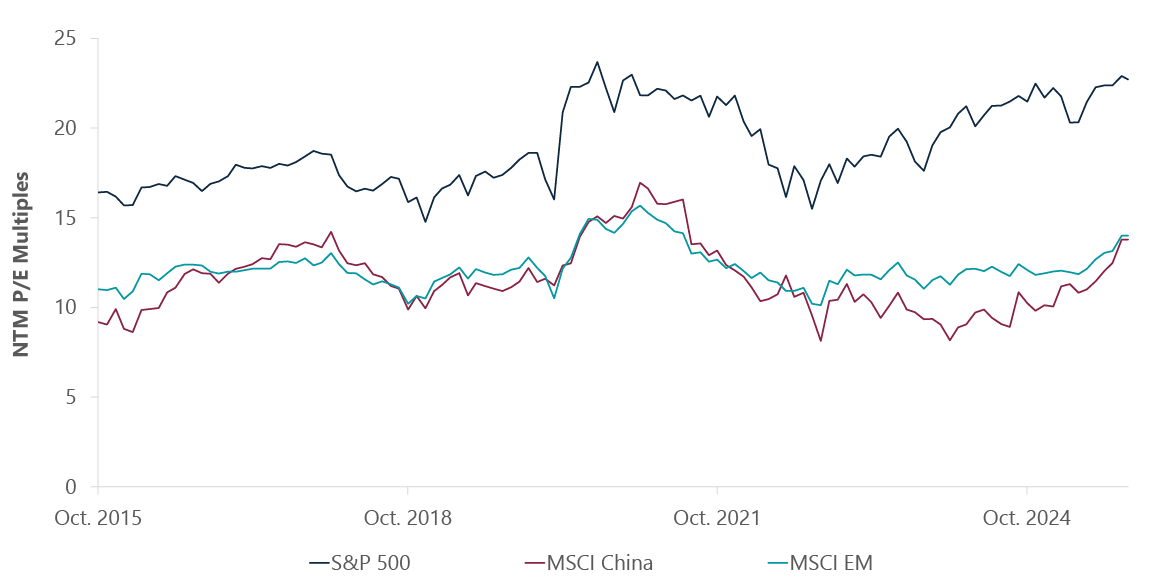
Emerging market equities have delivered strong results thus far in 2025, providing investors with year-to-date returns exceeding 30%. Despite this impressive performance, we believe the market recovery is still at an early stage, and that emerging markets (EM) continue to present significant upside, especially given their appealing valuations relative to developed markets. This valuation gap creates an opportunity for investors to tap into emerging market growth at favorable prices.
Exhibit 1: China — Valuation Opportunity Remains Compelling
Source: FactSet. Data as of Oct. 6, 2025.
Lower Dollar Environment
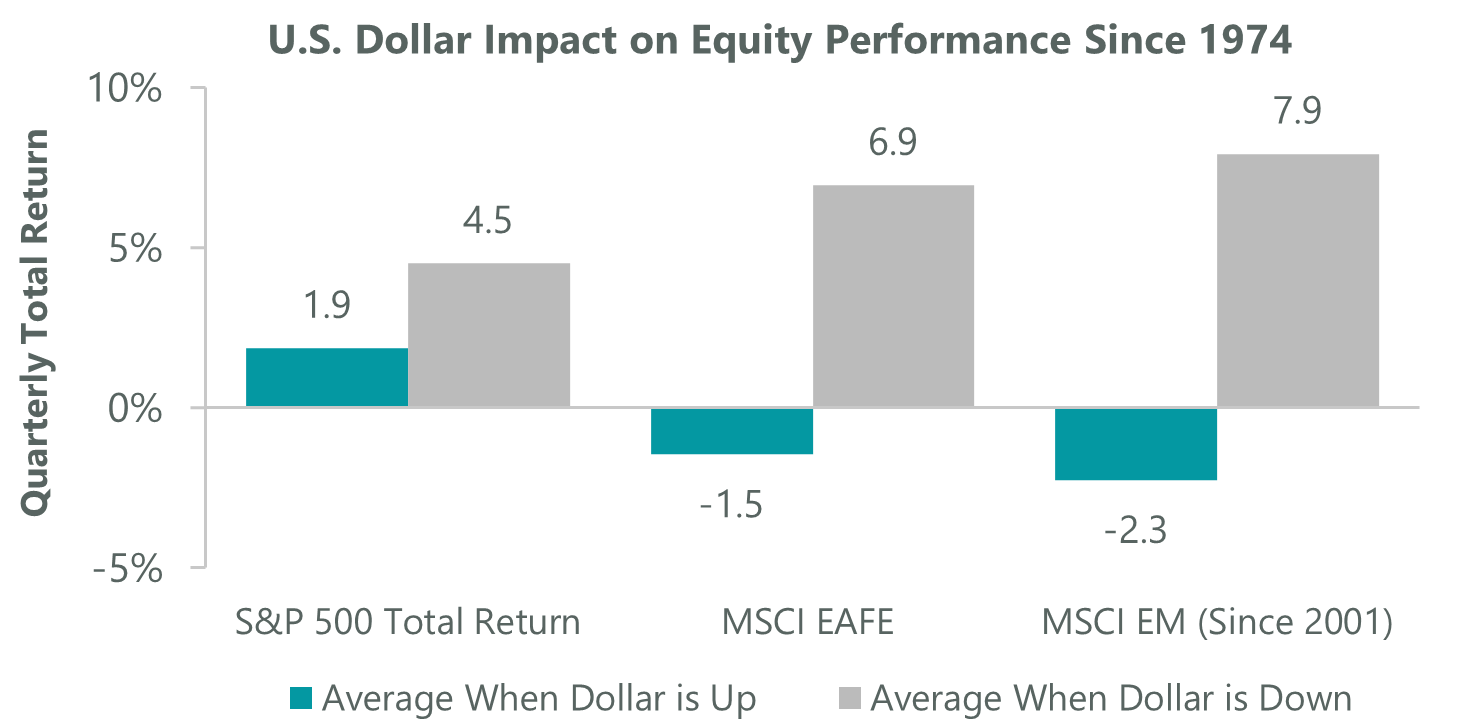
EM equities tend to benefit from a stable or depreciating U.S. dollar, making current conditions favorable for the asset class. This is a function of lower U.S.-denominated debt servicing costs, commodity exporter tailwinds and increased monetary policy flexibility facilitating falling rates and supporting economic growth. Additionally, this environment comes hand in hand with improved investor sentiment, fostering a virtuous cycle as increased foreign capital flows into the regions further enhance potential investment performance.
Exhibit 2: Sluggish Dollar Bodes Well for Emerging Markets Equities
Data as of Sept. 30, 2025. MSCI EAFE and MSCI EM are net returns; MSCI EM data starts in 2001. Sources: FactSet, S&P, MSCI. Investors cannot invest directly in an index, and unmanaged index returns do not reflect any fees, expenses or sales charges.
-
"Emerging Markets continue to present significant upside, especially given their appealing valuations relative to developed markets."
Long-Term Structural Drivers
Investing in emerging markets offers exposure to many countries offering economic growth rates faster than most developed nations. Additionally, EM provides exposure to long-term structural trends:
- China Recovery: The Chinese economy is in the early stages of a policy pivot from a focus on deleveraging toward one that targets growth. This creates company-level investment opportunities and encourages more global investor flows to return to China.
- AI Demand: The launch of China’s DeepSeek chatbot sent shockwaves around the world, highlighting Chinese advancement and shifting assumptions about the cost and scale needed for cutting-edge AI. In addition to China, several other EM countries are key developers of components critical for AI development, offering significant investment opportunities.
- India Growth: India offers great upside potential as it remains the fastest-growing major global economy, benefiting from a large and young population. Indian valuations have seen a correction back to long-term levels, reinforcing the importance of active management to gain exposure to company-level opportunities.
More broadly, EM equities provide exposure to companies benefiting from accelerated technological adoption, demographic shifts such as urbanization and the expansion of the middle class and financial inclusion. These businesses have world-class innovation capabilities across an array of sectors, all of which benefit from substantial investment in research and development and intellectual property creation. We believe these fundamental trends establish a robust foundation for ongoing economic development and corporate earnings growth in emerging markets.
Positioning and Diversification
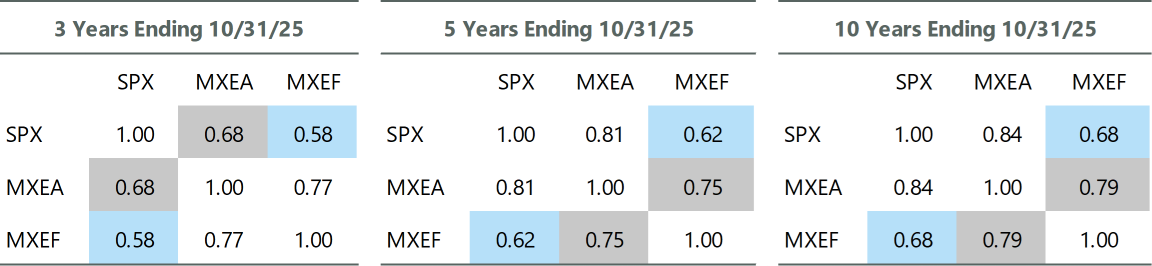
In addition to offering potential return upside, EM allocations offer diversification benefits that can reduce overall portfolio risk. EM stocks often have different economic cycles and sector exposures compared to developed markets, providing investors the potential for less correlated returns and better risk-adjusted performance.
Exhibit 3: Correlations Among Global Markets
Note: SPX represents the S&P 500 Index, MXEA the MSCI EAFE Index and MXEF the MSCI Emerging Markets Index. Source: FactSet. Data as of Oct. 6, 2025.
Such diversification can be particularly useful in periods when other asset classes struggle. For example, emerging markets have tended to outperform the U.S. market during periods of low U.S. returns. Specifically, in the rolling 10-year periods since 1971 when the S&P 500 Index has returned less than 6% annualized, the MSCI Emerging Markets Index has outperformed U.S. equities every time while delivering an annualized return of 12.1%1.
Sources
1Data as of September 30, 2025. Sources: Morningstar, S&P, MSCI.
Important Information
This information is issued and approved by ClearBridge Investment Management Limited(‘CIML’), authorised and regulated by the Financial Conduct Authority. It does not constitute investment advice. Market and currency movements may cause the capital value of shares, and the income from them, to fall as well as rise and you may get back less than you invested.
The information contained in this document has been compiled with considerable care to ensure its accuracy. However, no representation or warranty, express or implied, is made to its accuracy or completeness. ClearBridge Investments has procured any research or analysis contained in this document for its own use. It is provided to you only incidentally and any opinions expressed are subject to change without notice.
This document may not be distributed to third parties. It is confidential and intended only for the recipient. The recipient may not photocopy, transmit or otherwise share this [document], or any part of it, with any other person without the express written permission of ClearBridge Investment Management Limited.
The document does not form the basis of, nor should it be relied upon in connection with, any subsequent contract or agreement. It does not constitute, and may not be used for the purpose of, an offer or invitation to subscribe for or otherwise acquire shares in any of the products mentioned.
Past performance is not a guide to future returns.
The distribution of specific products is restricted in certain jurisdictions, investors should be aware of these restrictions before requesting further specific information.
The views expressed are opinions of the portfolio managers as of the date of this document and are subject to change based on market and other conditions and may differ from other portfolio managers or of the firm as a whole. These opinions are not intended to be a forecast of future events, research, a guarantee of future results or investment advice.
Please note the information within this report has been produced internally using unaudited data and has not been independently verified. Whilst every effort has been made to ensure its accuracy, no guarantee can be given.
Risk warnings – Investors should also be aware of the following risk factors which may be applicable to the strategy shown in this document.
- Investing in foreign markets introduces a risk where adverse movements in currency exchange rates could result in a decrease in the value of your investment.
- This strategy may hold a limited number of investments. If one of these investments falls in value this can have a greater impact on the strategy’s value than if it held a larger number of investments.
- Smaller companies may be riskier and their shares may be less liquid than larger companies, meaning that their share price may be more volatile.
- Emerging markets or less developed countries may face more political, economic or structural challenges than developed countries. Accordingly, investment in emerging markets is generally characterised by higher levels of risk than investment in fully developed markets.
- Index futures and FX forwards