
Content navigation

Key Takeaways
- Geopolitical shocks have not stopped emerging market equities from delivering strong returns, challenging dated views that they should be avoided whenever global risks increase.
- Today’s emerging markets look very different from the old risk playbook, with more diverse economies, global champions, stronger domestic growth drivers and a backdrop that looks increasingly supportive.
- For investors, the bigger risk may lie not in owning emerging markets in an uncertain world, but in waiting for certainty and an entry point that never comes.
War in Ukraine. Expanding conflict in the Middle East. Trade wars. Political uncertainty across multiple continents. By the old rulebook, emerging markets should have struggled in this environment: the first to sell off when headlines darkened, and the last to recover when risk appetite returned.
However, recent evidence has proved otherwise. Despite a near-constant stream of geopolitical turbulence over the past few years, many emerging market equities have delivered strong returns, including a rebound of over 30% for the MSCI Emerging Markets Index in 2025 alone and robust performance year-to-date in 2026 — even factoring in the July selloff. So why does the old “Emerging markets are too risky right now” instinct keep showing up, and is it still pointing at the right risks?
How Global Risks Shaped Views on Emerging Markets
This instinct is understandable and comes from real experience. For decades, emerging markets were tightly tied to oil and commodity prices, and when oil spiked or crashed emerging market currencies and stocks often moved in lockstep. On top of that, whenever global investors became nervous about a war, a Fed decision or a banking scare, money tended to flee emerging markets first and fastest. A crisis on the other side of the world could hit emerging market investments hard, even when the connection made little logical sense.
That pattern may have trained a generation of investors to treat geopolitical headlines as a warning light for emerging markets. For a long time, it was a reasonable signal to watch. However, that link is not as straightforward today.
Geopolitics May Matter Less Than It Used To
Today’s geopolitical shocks are less likely to be purely emerging market events. Trade disputes, wars, energy shocks and supply-chain disruption now ripple through developed and emerging markets alike.
It is also worth separating the headline from the underlying weakness. Many past emerging market selloffs were made worse by unpredictable local politics, weak currencies, heavy external debt or fragile banking systems. Today, we find that the gap between emerging and developed markets and economies is smaller, with many developed markets facing political uncertainty and high debt levels while several emerging markets sport more prudent macro foundations. Additionally, while geopolitical shocks can still create short-term volatility, they do not necessarily turn into deeper emerging market crises; with these markets no longer moving as one broad risk trade, a political shock that may be material for one country, sector or currency may have little direct relevance on another.
-
"For a long time, it was a reasonable signal to watch. However, that link is not as straightforward today."
Emerging Markets Have Changed
Many emerging market economies are now more diversified, less dependent on commodity exports and supported by deeper domestic capital markets than they were a generation ago. This makes them less vulnerable to the old pattern of foreign investors pulling money at the first sign of trouble.
India’s growth story, for example, is increasingly powered by domestic consumption and infrastructure investment, rather than global trade. Across the wider emerging market universe, the growth of services, manufacturing and domestically driven sectors has also made the asset class broader and more resilient.
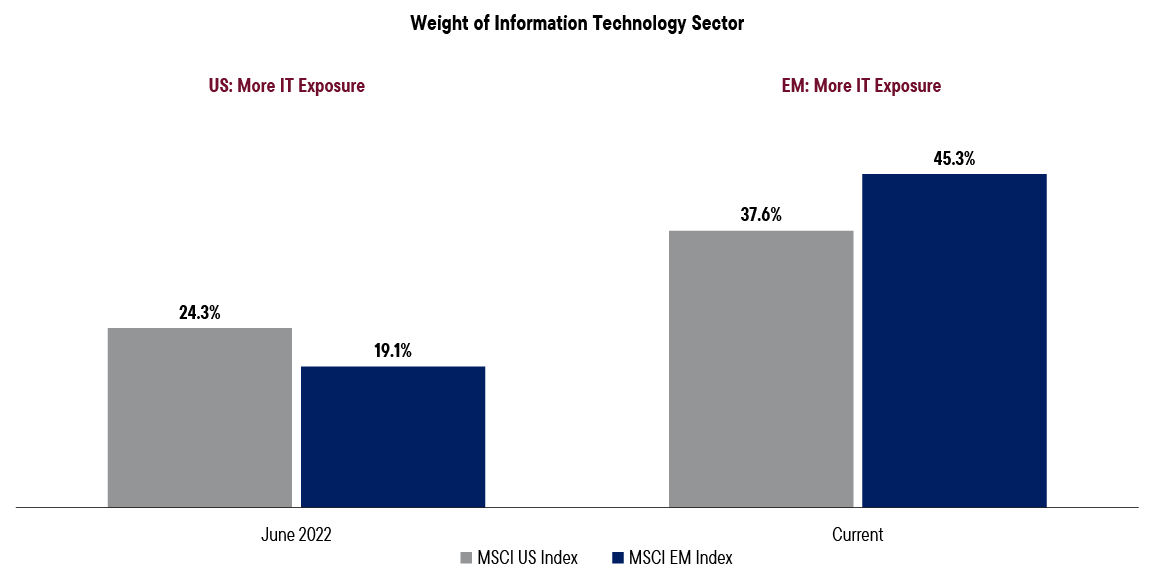
At the same time, emerging markets are becoming home to more leading global companies. Taiwan and South Korea provide meaningful exposure to advanced manufacturing and semiconductors, linking parts of the emerging market universe to global AI and broader technology demand rather than old-style commodity cycles (Exhibit 1). This makes emerging markets harder to dismiss as one simple risk trade.
Exhibit 1: Emerging Markets and the AI Trade
Data as of June 30, 2026. Sources: FactSet, MSCI.
The Starting Point Looks Attractive
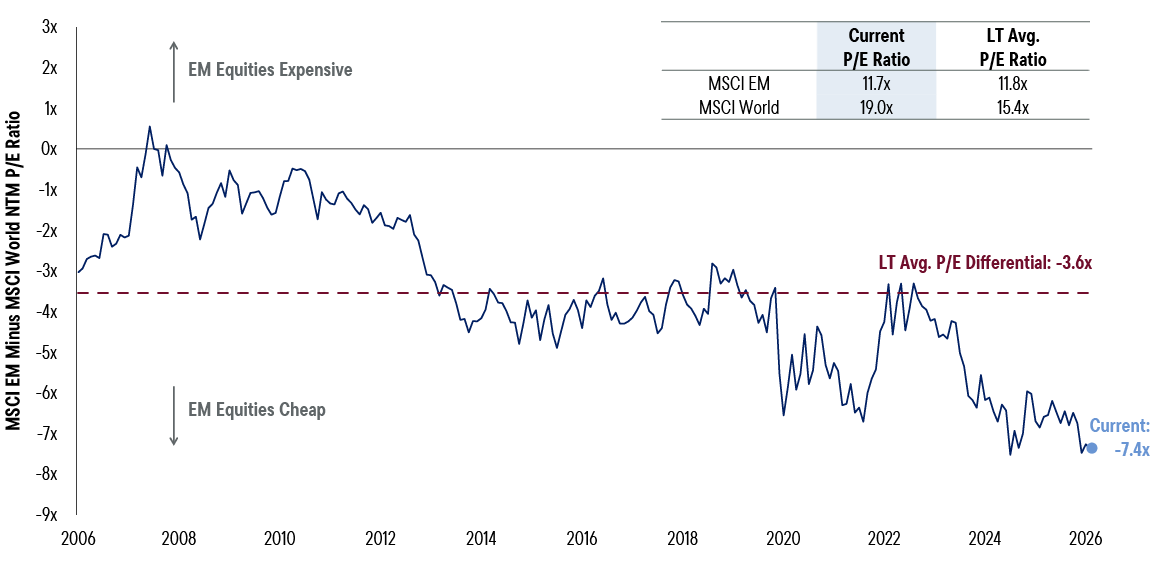
Even setting aside the decreasing geopolitical risk, we believe the investment backdrop for emerging markets looks attractive on its own terms. Emerging market stocks are currently priced at notably lower multiples compared to their global and U.S. counterparts, trading at discounts of 45% and almost 50%, respectively,1 leaving more room for upside if general sentiment improves (Exhibit 2). Furthermore, if the U.S. dollar continues to soften, the backdrop could become more accommodative to emerging market asset flows, further supporting prices.
Exhibit 2: Emerging Markets Valuations Historically Attractive
Data as of June 30, 2026. Sources: FactSet, MSCI.
Waiting For Certainty May Mean Missing Out
Geopolitical uncertainty is not a temporary condition to be waited out — it is the baseline. There has rarely been a multiyear period in modern market history free of war, trade disputes, election upheaval or diplomatic crisis somewhere in the world. Many emerging market countries are in a better position, both politically and economically, than they have been historically. Treating geopolitical calm as a precondition for emerging market investment does not remove risk; it may simply mean missing the opportunity. For investors, the bigger risk may not be owning emerging markets in an uncertain world but in waiting for a certainty and an entry point that never comes.
Important Information
This information is issued and approved by ClearBridge Investment Management Limited (‘CIML’), authorised and regulated by the Financial Conduct Authority. It does not constitute investment advice. Market and currency movements may cause the capital value of shares, and the income from them, to fall as well as rise and you may get back less than you invested.
The information contained in this document has been compiled with considerable care to ensure its accuracy. However, no representation or warranty, express or implied, is made to its accuracy or completeness. ClearBridge Investments has procured any research or analysis contained in this document for its own use. It is provided to you only incidentally and any opinions expressed are subject to change without notice.
This document may not be distributed to third parties. It is confidential and intended only for the recipient. The recipient may not photocopy, transmit or otherwise share this [document], or any part of it, with any other person without the express written permission of ClearBridge Investment Management Limited.
The document does not form the basis of, nor should it be relied upon in connection with, any subsequent contract or agreement. It does not constitute, and may not be used for the purpose of, an offer or invitation to subscribe for or otherwise acquire shares in any of the products mentioned.
Past performance is not a guide to future returns.
The distribution of specific products is restricted in certain jurisdictions, investors should be aware of these restrictions before requesting further specific information.
The views expressed are opinions of the portfolio managers as of the date of this document and are subject to change based on market and other conditions and may differ from other portfolio managers or of the firm as a whole. These opinions are not intended to be a forecast of future events, research, a guarantee of future results or investment advice.
Please note the information within this report has been produced internally using unaudited data and has not been independently verified. Whilst every effort has been made to ensure its accuracy, no guarantee can be given.
Risk warnings – Investors should also be aware of the following risk factors which may be applicable to the strategy shown in this document.
- Investing in foreign markets introduces a risk where adverse movements in currency exchange rates could result in a decrease in the value of your investment.
- This strategy may hold a limited number of investments. If one of these investments falls in value this can have a greater impact on the strategy’s value than if it held a larger number of investments.
- Smaller companies may be riskier and their shares may be less liquid than larger companies, meaning that their share price may be more volatile.
- Emerging markets or less developed countries may face more political, economic or structural challenges than developed countries. Accordingly, investment in emerging markets is generally characterised by higher levels of risk than investment in fully developed markets.
- Index futures and FX forwards