
Content navigation

Key Takeaways
- The AI opportunity extends past U.S. leaders to the infrastructure layer that enables AI at scale. Emerging markets companies command highly consolidated parts of this AI hardware supply chain, where scale, technical expertise and high barriers to entry can support pricing power and attractive returns.
- The recent volatility in semiconductor stocks, a key part of the AI infrastructure buildout, and EM equities overall appears disconnected from any material change in long-term fundamentals.
- China is building a parallel AI ecosystem, supported by policy, domestic demand and a drive for technological self-sufficiency.
The artificial intelligence boom has been led by Silicon Valley, but the next phase of value creation may be decided by physical bottlenecks. Every model, chatbot and productivity tool depends on a vast physical network of chips, memory, servers, power systems and cooling equipment. Many of the companies that control these scarce inputs are based in emerging markets, creating a different way to access AI growth: not by chasing the most visible applications, but by identifying the infrastructure champions that allow AI to scale.
The EM Bottlenecks Behind AI
Many of the most critical components of AI infrastructure are produced by a small and increasingly consolidated group of highly specialized companies. A significant share of that expertise sits in Taiwan and South Korea. Taiwan is central to the advanced chips and servers that power AI systems, while South Korea supplies the high-performance memory needed to process vast amounts of data quickly. Other specialist manufacturers help bring these parts together so they can be used by the large cloud computing companies. As AI systems become bigger and more powerful, they also need more electricity, better cooling and faster connections between all the different pieces of hardware.
This means that while much of the spending originates with U.S. cloud platforms that need more data centers and computing power, a meaningful share of the economics can accrue to EM companies. In other words, industry profits are not confined to the companies building the applications; they can also sit with the infrastructure champions that make those applications possible.
The investment case is strengthened by industry structure. Many parts of the semiconductor and hardware supply chain have consolidated dramatically over the past decade. That consolidation gives the strongest companies better pricing power, stronger returns on capital and a larger share of the value created by the AI infrastructure cycle. For investors, the opportunity is not simply to buy AI growth, but to identify where scarcity, scale and consolidation allow that growth to translate into attractive economics.
Exhibit 1: EM Tech Earnings Growth Moderating Valuations
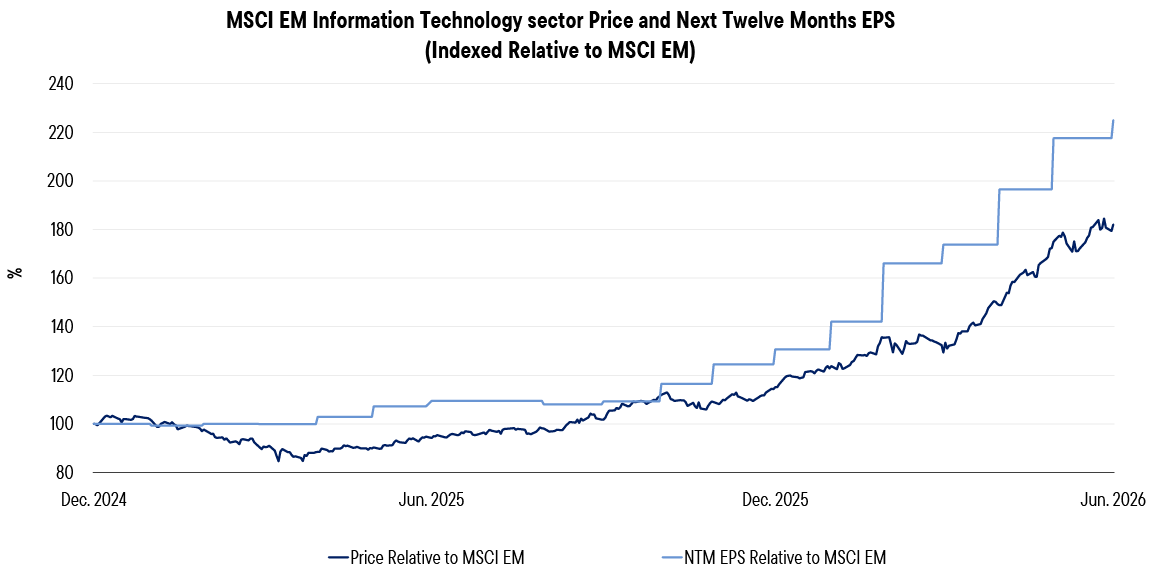
Source: FactSet as of 30 June 2026.
This opportunity is not without risk. Technology cycles can be volatile, capital requirements are significant and geopolitical tensions remain an important consideration. This is where active management becomes critical: continuously assessing AI developments around the world and understanding how they may affect individual portfolio holdings.
The recent volatility in semiconductor stocks appears disconnected from any material change in long-term fundamentals. While investors may be reassessing expectations and risk appetite, share prices can often react more sharply than the underlying outlook would suggest in the short term. Over longer periods, however, investment returns are ultimately driven by a company’s ability to execute, grow earnings and deliver on its fundamentals.
China: A Parallel AI Ecosystem
China deserves its own place in this discussion because its AI ecosystem is developing differently and should therefore be viewed through a different lens. U.S. restrictions on access to the most advanced chips and semiconductor manufacturing tools have made the path more difficult. But rather than stopping China’s AI ambitions, those constraints have reinforced the strategic importance of building a more domestic technology stack.
China is now building a more self-contained AI supply chain that spans domestic chips, servers, cloud platforms, models and applications. Its technology is not directly comparable with the leading global ecosystem at the individual chip level, but China is reconfiguring the problem. Where access to the most advanced hardware is constrained, it can still pursue scale, local optimization, cheaper deployment models and tighter hardware-software integration.
For investors, the China story is therefore not simply about catch-up. It is about the emergence of a separate AI ecosystem shaped by constraint, policy support, local demand and cost advantage. China may not win by matching the frontier chip-for-chip; it may succeed by optimizing around constraint through scale, cost discipline and hardware-software integration.
The Long-Term Opportunity
In the AI era, emerging markets are not peripheral; they are central to the infrastructure that makes AI possible. While Silicon Valley may capture the headlines, some of the most compelling opportunities may lie with the emerging market companies that supply the infrastructure behind AI. The next phase of AI investing may be less about who builds the most visible applications, and more about who controls the scarce capacity that allows those applications to scale.
Important Information
This information is issued and approved by ClearBridge Investment Management Limited (‘CIML’), authorised and regulated by the Financial Conduct Authority. It does not constitute investment advice. Market and currency movements may cause the capital value of shares, and the income from them, to fall as well as rise and you may get back less than you invested.
The information contained in this document has been compiled with considerable care to ensure its accuracy. However, no representation or warranty, express or implied, is made to its accuracy or completeness. ClearBridge Investments has procured any research or analysis contained in this document for its own use. It is provided to you only incidentally and any opinions expressed are subject to change without notice.
This document may not be distributed to third parties. It is confidential and intended only for the recipient. The recipient may not photocopy, transmit or otherwise share this [document], or any part of it, with any other person without the express written permission of ClearBridge Investment Management Limited.
The document does not form the basis of, nor should it be relied upon in connection with, any subsequent contract or agreement. It does not constitute, and may not be used for the purpose of, an offer or invitation to subscribe for or otherwise acquire shares in any of the products mentioned.
Past performance is not a guide to future returns.
The distribution of specific products is restricted in certain jurisdictions, investors should be aware of these restrictions before requesting further specific information.
The views expressed are opinions of the portfolio managers as of the date of this document and are subject to change based on market and other conditions and may differ from other portfolio managers or of the firm as a whole. These opinions are not intended to be a forecast of future events, research, a guarantee of future results or investment advice.
Please note the information within this report has been produced internally using unaudited data and has not been independently verified. Whilst every effort has been made to ensure its accuracy, no guarantee can be given.
Risk warnings – Investors should also be aware of the following risk factors which may be applicable to the strategy shown in this document.
- Investing in foreign markets introduces a risk where adverse movements in currency exchange rates could result in a decrease in the value of your investment.
- This strategy may hold a limited number of investments. If one of these investments falls in value this can have a greater impact on the strategy’s value than if it held a larger number of investments.
- Smaller companies may be riskier and their shares may be less liquid than larger companies, meaning that their share price may be more volatile.
- Emerging markets or less developed countries may face more political, economic or structural challenges than developed countries. Accordingly, investment in emerging markets is generally characterised by higher levels of risk than investment in fully developed markets.
- Index futures and FX forwards