
Content navigation

Key Takeaways
- India represents a long term growth opportunity underpinned by favorable demographics and rising domestic consumption.
- The Indian government is implementing a steady program of business-friendly structural reforms that we believe should support business returns.
- Indian equities offer diversification and active opportunities within emerging markets, driven by a domestically focused economy and relatively low correlation to other developing markets.
Recent Disconnect Between GDP Growth and Equity Valuations
India is the world’s fastest-growing large economy, with forecasts for real gross domestic product (GDP) growth of 6.2% in 20261— approximately 50% faster than the broader emerging market universe and almost four times that of advanced economies.
The Indian equity market significantly outperformed between 2021 and 2024, driven by this rapid economic growth and structural reforms. However, 2025 provided a healthy valuation correction, bringing equity multiples back to long-term average levels and creating what we view as a more attractive environment for potential investment upside.
We believe Indian equities are worth a closer look as they bring many advantages to an emerging markets portfolio:
1. Resilience: Long Term Growth Drivers
India is known for its large and young population, which provides a significant boost to economic growth and supports an expanding middle class, paving the way for increased consumption. This creates viable investments as it widens the opportunity set of fast-growing, quality businesses benefiting from a vast, increasingly domestic consumer market.
Exhibit 1: Income Levels Poised to Increase
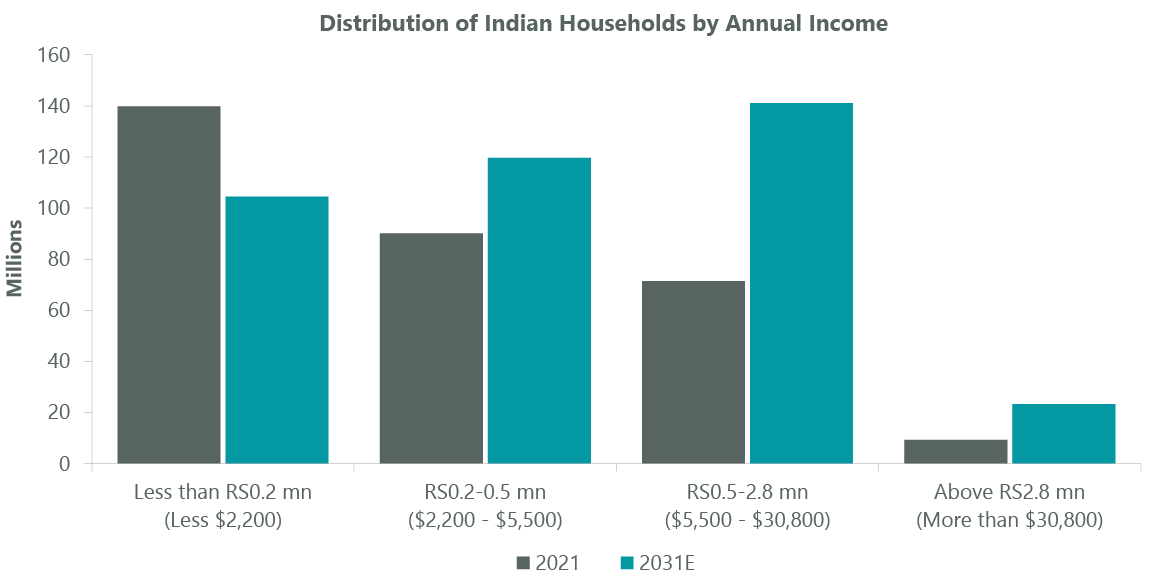
As of February 2026. Source: WEF, Kotak Institutional Equities estimates. Data range: March fiscal year-ends, 2021-31E (mn).
RS = rupees. USD values, as of Feb. 25, 2026.
2. Reforms: Business-Friendly Improvements
Historically, one of the biggest hurdles of doing business in India has been excessive regulatory red tape, but Indian companies are now benefiting from policy reform initiatives. Such reforms may not be as flashy as India’s underlying growth drivers, but they are helping to enhance the business backdrop. The steady, measured progress businesses are making gives us additional confidence in India’s long-term growth trajectory.
For example, one of the key reforms of the last decade has been the introduction of a countrywide goods and services tax in 2017. This national policy replaced a complex suite of central and state-level taxes and regulations, enabling companies to implement more efficient logistics through the elimination of requirements such as mandatory freight inspections and state-level tax payments at interstate boarders.
In addition to ongoing initiatives to simplify goods and services tax frameworks, other recent examples of business-friendly reforms include last year’s streamlining and consolidating of India’s labor code and laws. Given the scale of India’s large workforce, we believe this marks a positive step forward for the country.
Finally, we have seen radical tax changes, in particular significant reductions in corporation taxes that should greatly improve India’s competitiveness as a place to do business and enhance the future profitability of Indian companies.
Exhibit 2: Corporate Tax Rates Becoming More Competitive Versus Rest of Asia
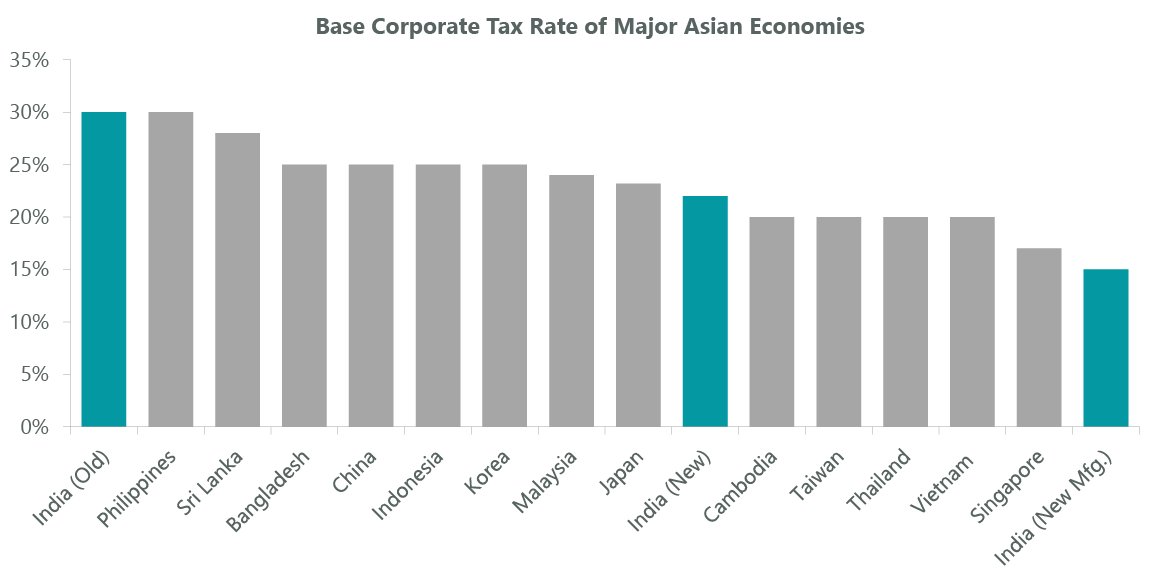
As of February 2026. Source: Deloitte, KPMG, Kotak Institutional Equities. Data: 2023 calendar year-ends.
-
"Given the scale of India’s large workforce, we believe this marks a positive step forward for the country."
3. Road Ahead: Diversified Opportunities
While India is known for benefiting from its “demographic dividend,” what may be less apparent is the vast breadth of investment opportunities the country offers. The Indian market features over 5,000 listed companies spanning a wide range of sectors and industries.
India is actively expanding and diversifying its manufacturing capabilities and is increasingly being seen as a compelling alternative to China for sourcing technology hardware. For example, 20% of all iPhones are now assembled in India,2 a number expected to keep rising as manufacturing supply chains in India mature.
India’s culture of innovative and fast technology adoption, along with its large, tech-savvy workforce, is also helping to facilitate the rapid adoption of AI, which we expect will have significant implications across a wide range of sectors. And, importantly, India’s vibrant start-up economy is supported by a growing domestic investment community.
Exhibit 3: MSCI India Sector Weights
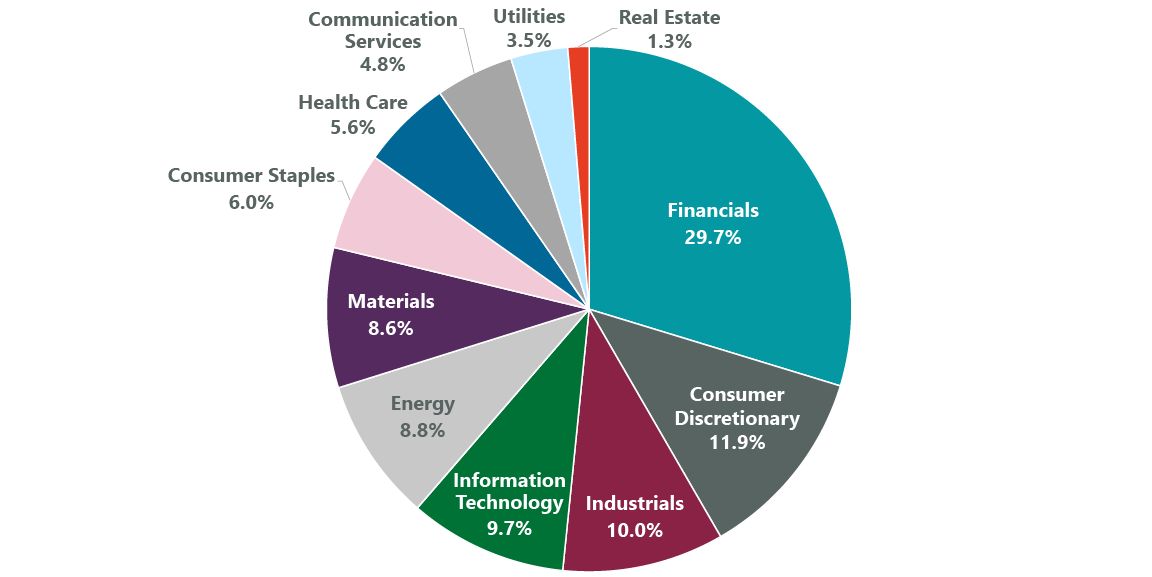
As of Jan. 30, 2026. Source: MSCI India Index (USD).
India’s investment story is built on solid foundations: strong long term growth drivers, a steady pace of reform and an economy that is increasingly diversifying. With growth continuing to outpace peers and valuations having eased back to more reasonable levels, we believe Indian equities are well-placed to play a valuable role within an emerging markets portfolio.
Sources
1 Source: IMF, as of Feb. 17, 2026
2 Source: Techwire Asia as of Aug. 22, 2025
Important Information
This information is issued and approved by ClearBridge Investment Management Limited (‘CIML’), authorised and regulated by the Financial Conduct Authority. It does not constitute investment advice. Market and currency movements may cause the capital value of shares, and the income from them, to fall as well as rise and you may get back less than you invested.
The information contained in this document has been compiled with considerable care to ensure its accuracy. However, no representation or warranty, express or implied, is made to its accuracy or completeness. ClearBridge Investments has procured any research or analysis contained in this document for its own use. It is provided to you only incidentally and any opinions expressed are subject to change without notice.
This document may not be distributed to third parties. It is confidential and intended only for the recipient. The recipient may not photocopy, transmit or otherwise share this [document], or any part of it, with any other person without the express written permission of ClearBridge Investment Management Limited.
The document does not form the basis of, nor should it be relied upon in connection with, any subsequent contract or agreement. It does not constitute, and may not be used for the purpose of, an offer or invitation to subscribe for or otherwise acquire shares in any of the products mentioned.
Past performance is not a guide to future returns.
The distribution of specific products is restricted in certain jurisdictions, investors should be aware of these restrictions before requesting further specific information.
The views expressed are opinions of the portfolio managers as of the date of this document and are subject to change based on market and other conditions and may differ from other portfolio managers or of the firm as a whole. These opinions are not intended to be a forecast of future events, research, a guarantee of future results or investment advice.
Please note the information within this report has been produced internally using unaudited data and has not been independently verified. Whilst every effort has been made to ensure its accuracy, no guarantee can be given.
Risk warnings – Investors should also be aware of the following risk factors which may be applicable to the strategy shown in this document.
- Investing in foreign markets introduces a risk where adverse movements in currency exchange rates could result in a decrease in the value of your investment.
- This strategy may hold a limited number of investments. If one of these investments falls in value this can have a greater impact on the strategy’s value than if it held a larger number of investments.
- Smaller companies may be riskier and their shares may be less liquid than larger companies, meaning that their share price may be more volatile.
- Emerging markets or less developed countries may face more political, economic or structural challenges than developed countries. Accordingly, investment in emerging markets is generally characterised by higher levels of risk than investment in fully developed markets.
- Index futures and FX forwards